
Revision Rhinoplasty Houston
Dr. Etai Funk, a trusted revision rhinoplasty surgeon in Houston, understands the emotional and physical frustration patients may experience after an unsatisfactory rhinoplasty. Many patients seek revision rhinoplasty in Houston not only for aesthetic improvement but also to restore breathing function compromised by previous surgery. Dr. Funk treats revision rhinoplasty patients throughout Houston, Katy, Memorial City, The Woodlands, Spring Cypress, and Sugar Land. When revision surgery is appropriate, he works closely with each patient to design a personalized surgical plan focused on restoring harmony, improving breathing, and achieving natural-looking results.
As a double board-certified facial plastic surgeon and ENT specialist, Dr. Funk is uniquely qualified to address both cosmetic concerns and airway dysfunction. Functional issues may arise from:
- Over-resection of cartilage in the nasal tip
- Internal or external nasal valve collapse
- Persistent deviated septum
- Turbinate hypertrophy
- Loss of structural nasal support

Revision Rhinoplasty Explained
Revision rhinoplasty (sometimes called secondary rhinoplasty) is a type of corrective surgery performed on patients who have had previous rhinoplasty or septoplasty that did not achieve the desired cosmetic or functional result. This procedure addresses concerns such as:
- Pinched or asymmetrical nasal tip
- Dorsal irregularities or persistent hump
- Over-resected cartilage or structural collapse
- Valve collapse causing breathing difficulty
- Deviated septum or turbinate hypertrophy not corrected during prior surgery
- Nasal airway obstruction after rhinoplasty
- Unsatisfactory cosmetic outcome or loss of nasal support
Unlike primary rhinoplasty, revision rhinoplasty is significantly more complex due to scar tissue, weakened cartilage, and altered nasal anatomy. Successful outcomes require advanced surgical planning and a facial plastic surgeon experienced in both cosmetic and functional nasal reconstruction.
Dr. Etai Funk specializes in revision rhinoplasty in Houston, frequently receiving referrals from physicians, patients, and families throughout Houston and across Texas seeking correction after a previous nose surgery. Named a Top Houston rhinoplasty surgeon by RealSelf and Super Doctors, Dr. Funk is a double board-certified facial plastic surgeon and ENT specialist dedicated exclusively to facial procedures.
With more than 200 rhinoplasty surgeries performed each year, he brings extensive experience to complex revision cases, carefully evaluating whether meaningful improvement is achievable and developing a personalized surgical plan designed to restore function, enhance facial harmony, and deliver natural, confidence-boosting results while ensuring a supportive, memorable, and positive surgical experience.
Our Revision Rhinoplasty Technique Difference
contact our expertRevision Rhinoplasty Surgery & Recovery Process
Consultation
When visiting our Houston office for a revision rhinoplasty consultation, you will meet with Dr. Funk to discuss your concerns regarding your nose after your previous surgery(s). Dr. Funk will focus on your functional breathing issues, what you did not like about the previous surgery, and what your major cosmetic concerns are since your last procedure.
Dr. Funk will then examine your nose on the inside and out. He may need to pass a camera inside your nose and assess your septum to ensure you still have some cartilage there for grafting purposes. Photographs will be taken and you and Dr. Funk will sit in his office reviewing these photographs and making digital changes to provide an approximation of what revision rhinoplasty can achieve. You and Dr. Funk will review before and after photos of revision rhinoplasty patients who have had surgery with Dr. Funk. Once all your questions are answered, you will meet with our patient care coordinator to review the quote for revision rhinoplasty. This may take insurance into consideration if you have functional breathing issues.
Preoperative Appointment
Your preoperative appointment will usually occur the day prior to surgery. On this day, you will meet with Dr. Funk once more to re-discuss your goals for the surgery, review the risks of revision rhinoplasty, and discuss some of the healing processes. The majority of the time will be spent with the patient care coordinator who will discuss preoperative and postoperative care. They will review what you can expect after surgery, things that may cause concern, and what should appear as normal healing versus abnormal. Your final payment will also be collected at this time.
Day of Surgery/Procedure
On the day of your revision rhinoplasty surgery, you will check-in at the facility and then move on to the preop area. There you will change into a surgical gown and have an IV started. Consent forms will be signed and you will meet the surgical team. You will then move on to the operating room. Your revision rhinoplasty will be performed in Houston usually at a surgery center. Dr. Funk typically performs his rhinoplasty under general anesthesia. Revision rhinoplasty usually takes between 2-3 hours depending on the amount of work. You will be taken to the recovery room after surgery.
Revision Rhinoplasty Recovery
Recovery after revision rhinoplasty depends on the extent of work that is required. Revision rhinoplasty is not a painful procedure but is described more as uncomfortable. Patients feel very congested during the first few days and this slowly improves. Patients are social after 8-10 days and able to return to a full workout routine at 2 weeks. Swelling is definitely more prolonged in revision rhinoplasty than primary rhinoplasty. 10% of swelling is down at 3-4 weeks, 30% at 8 weeks, but it will take a full 1.5 years for all the swelling to subside.
Frequently Asked Questions About Revision Rhinoplasty
Revision rhinoplasty typically costs more than a primary rhinoplasty due to its added complexity, often requiring cartilage grafting and longer operative time. Pricing depends on your specific correction needs. Dr. Etai Funk provides a personalized quote for Houston revision rhinoplasty patients after a detailed consultation and examination.
Revision rhinoplasty is a surgical procedure performed to enhance the appearance of the nose or the nasal airway after the nose has already been operated on. Patients may feel they had a "bad nose job" or are unhappy with their rhinoplasty results.
You may have breathing difficulty after nose surgery that requires a revision rhinoplasty to correct a deviated septum, valve collapse, or enlarged turbinates. You may also have cosmetic concerns that you would like addressed with revision rhinoplasty. Whether the nose is crooked, there is a residual hump, or it is left too wide, or you are simply not happy with results after rhinoplasty.
These are all signs you may be a candidate for revision rhinoplasty.
Dr. Funk will evaluate the external appearance of your nose and assess whether he feels that he may be able to provide an approvement on the appearance of your nose. If your breathing is an issue, this can typically be corrected by treating a residual or recurring deviated nasal septum, the nasal valves, or the turbinates.
How long to wait for a revision rhinoplasty can vary but typically it takes a full year for the nose to completely heal and the swelling to subside after rhinoplasty.
However, some patients with very thick skin may take 1.5-2 years until there swelling subsides. Dr. Funk will perform a thorough evaluation to assess your nose and decide if you are ready for revision rhinoplasty.
I have long discussions with my Houston revision rhinoplasty patients informing them that the healing process does take longer than with primary rhinoplasty or first time nose job patients. There are multiple reasons for this.
Every time a rhinoplasty is performed, scar tissue is left behind between the skin and cartilage. This scar tissue envelops the cartilage and makes it less malleable and more difficult to shape. After the revision rhinoplasty there is new scar tissue deposited on top of the old scar tissue from the previous rhinoplasty.
This leads to longer healing time and less predictable wound healing. One can expect swelling at 3 months with revision rhinoplasty to be the equivalent of swelling at 1 month with primary rhinoplasty which is about 30%.
There are no finite amounts of rhinoplasty surgeries a patient can have. However, after each rhinoplasty, there is more scar tissue present which can make the surgery more difficult. At times, a decision has to be made as to whether another rhinoplasty surgery will make an improvement. During the consultation, Dr. Funk will evaluate your nose and concerns. He will discuss what can be improved and what areas of the nose cannot.
Revision rhinoplasty requires the surgeon to get through a considerable amount of scar tissue and deal with a previously operated nose. This can be considerably difficult. The nasal skin may be quite adherent to the residual cartilage. This cartilage may also be weak and collapsed. There may not be suffiicient cartilage left in the septum for grafting purposes which may lead to the need for ear or rib cartilage. The healing process is quite different as now there is a new layer of scar forming on top of an old layer of scar. This may lead to more unpredictabliity regarding how the nose heals. Lastly, there may be functional compromise or breathing issues with the nose after the previous rhinoplasty or nose job that will need to be fixed with revision rhinoplasty.
A pollybeak deformity occurs in the area just above the tip defining point of the nose. This typically occurs after rhinoplasty when not enough cartilage was taken down in this area or if excessive scar tissue built up in this region. Thicker skinned patients may be more prone to developing a pollybeak deformity after nose surgery or a nose job.
Nose surgery or rhinoplasty is not a painful surgery, but is an uncomfortable one. No one wants to have to go through the discomfort of another surgery. After a poor result from a nose job, you may become skeptical of the plastic surgery experience and plastic surgeons or facial plastic surgeons in general. Understandably so! It takes a lot of courage to see a surgeon for a revision surgery. Your first step is making that appointment with a credible, board certified surgeon who is well versed and experienced in revision rhinoplasty surgery.
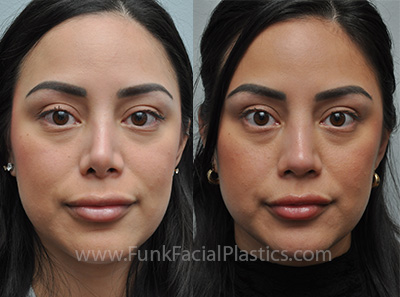
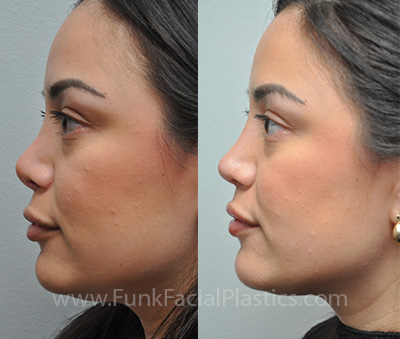
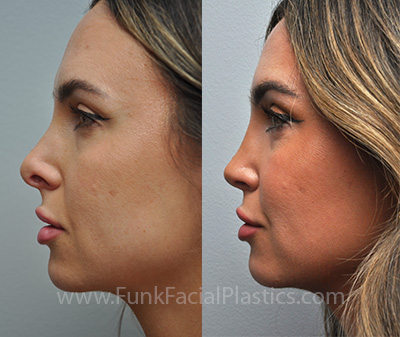
Rhinoplasty is an extremely difficult operation. You are dealing with a three-dimensional object composed of both cartilage, bone, and soft tissue. Function and form must be accounted for and a natural result is essential. The nasal tip cartilages can become particularly twisted and knuckled after nose surgery and frequently must be completely reconfigured to an even and symmetric nasal tip. The patient below underwent revision rhinoplasty after a previous nose surgery left her nasal tip quite uneven and irregular. Notice the more symmetric nose with better lines and a natural unoperated result.
Many patients who come in for consultations for revision rhinoplasty surgeries are still concerned about a bulbous tip. Refining the nasal tip depends on previous surgeries and the amount of scar tissue. One can expect improvement anywhere between 5% to 50% for a bulbous nasal tip.
Revision septoplasty can be a challenging procedure like revision rhinoplasty. Sometimes the entire deviated septum needs to be removed, straightened and then replaced during revision septoplasty. Scheduling a consultation with Dr. Funk at his Houston office is best to evaluate your needs.
Yes. Revision rhinoplasty is more difficult than primary rhinoplasty for numerous reasons. After the initial surgery, there is scarring that is formed between the skin and the bony and cartilage framework of the nose. This makes for a more difficult dissection during rhinoplasty and more unpredictable healing. In addition, during the first surgery, septal cartilage may have been taken and used for grafting purposes. In this case, residual septal cartilage may be insufficient or unstable for the revision rhinoplasty. Ear cartilage or rib cartilage may need to be used for revision rhinoplasty.
Difficulty breathing or other breathing issues after rhinoplasty can be due to numerous anatomical or healing concerns. A deviated septum may not have been addressed or the deviation to the septum may have returned and lost its correction. Another major cause of nasal airway obstruction after rhinoplasty or nose job is nasal valve collapse. If the internal nasal valve and external nasal valve are not respected, supported, or treated during surgery, this can lead to nasal vavle insufficiency.
Dr. Funk performs many revision septoplasties and rhinoplasties in which the nasal valve was not addressed in order to improve nasal breathing. Lastly, the turbinates may be enlarged. These are structures that act to humidify and moisten the air as it passes through the inside of the nose. Somes inferior turbinates need to be made smaller in order to allow greater passage of air through the nose. For Houston patients, more of the turbinates can be reduced during rhinoplasty due to the humid climate.
Ear cartilage or rib cartilage may be needed for grafts during revision rhinoplasty. Depending on the presence and amount of residual septal cartilage, these other sources of cartilage are frequently necessary to provide structural integrity back to the nose.
Removing ear cartilage for revision rhinoplasty will NOT alter the shape of the ear. Post operatively there is minimal pain from the ear and there are no stitches to be removed.
Rib cartilage for revision rhinoplasty (costal cartilage) requires a small incision in the fold under the breast or chest. The scar heals extremely well in this fold and is hidden by the bra/bikini in women. The pain is well tolerated post-operatively. If your own rib cartilage is not suitable or your do not desire this, another option is cadaveric irradiated rib cartilage.

Why Choose Funk Facial Plastic Surgery for Revision Rhinoplasty in Houston
Cosmetic surgery of the face and neck should be performed by a board certified surgeon who understands the intricate anatomy of the region while at the same time comprehending aesthetic principles.
Dr. Funk is a double board certified head and neck surgeon and facial plastic surgeon who specializes in cosmetic surgery of the face. He performs close to 200 rhinoplasties per year and has performed hundreds of facelifts and eyelid lifts or blepharoplasty. His goal is to provide you with a natural, long-lasting, and beautiful result while at the same time minimizing your downtime.



Talk To Your Doctor
ask dr. funk a question